
DATA CENTRE
12 Fibres vs. 8 Fibres: Who Wins in Next-Gen AI Data Centre Networks?


As data centres transform into AI-driven compute powerhouses, one shift has sparked curiosity across engineering teams: why are networks moving from the “high-capacity” 12-fibre standard back to an 8-fibre design? At first it sounds like a step backwards — fewer fibres, lower numbers — but in reality it marks a major leap in efficiency and fibre utilization.
In this post, we’ll walk through the evolution of optical transceiver technology across four rounds of comparison to uncover what’s behind this change. Plus a wrap up by sharing how Aginode’s upgraded LANmark ENSPACE Base8 platform is purpose-built for the new AI-era data centre.
ROUND 1 — Around 2010
10G SFP+ (10GBASE-SR, Base-2)
12-fibre systems:
Using an MPO-to-LC breakout, a 12-fibre cable delivers six duplex (2-fibre) channels, which aligned well with early data-centre designs that required “many small 10G nodes.” All fibres are used, giving 100% utilisation.
8-fibre systems:
After breakout, an 8-fibre cable provides four duplex channels. Fibre utilisation also remains 100%, but overall port density is reduced to two-thirds of what a 12-fibre system can support — a constraint in environments with high node counts.
Verdict: 12 fibres fit the era.
Why:
Most data centres of the early 2010s relied on many small, low-bandwidth nodes built around 10G duplex optics. The 12-fibre MPO system fit this perfectly, matching 10G requirements and the standard 12-fibre colour coding.
As a result, it quickly became the default architecture for early high-density data centre deployments.
ROUND 2 — Around 2013–2015
40G QSFP+ (40GBASE-SR4, Base-8)
12-fibre systems:
A 40G transceiver requires only 8 fibres (4 Tx + 4 Rx), leaving 4 fibres in a 12-fibre trunk permanently unused. Still, because most data centres already have an extensive 12-fibre infrastructure in place, many organisations continued using it to avoid the cost and disruption of a full cabling overhaul.
8-fibre systems:
An 8-fibre design matches the 40G/100G requirement exactly, achieving full utilisation and enabling roughly 25% higher rack-level density for the same number of links. However, adoption remained limited—primarily driven by hyperscalers deploying new facilities where they could design cleanly around 8-fibre architectures.
Verdict: A draw.
Why:
This period became a true transition phase.
12-fibre systems persisted because so much legacy infrastructure was already in place, while 8-fibre architectures gained traction mainly in greenfield builds. Neither approach became universally dominant—each thrived in its own segment of the market.
ROUND 3 — Around 2016–2022
100G QSFP28 (100GBASE-SR4, Base-8)
12-fibre systems:
AI clusters pushed scale to new extremes—often tens of thousands of 100G links per cluster. In a 12-fibre architecture, one-third of the fibres in every link go unused. At cluster scale, that means paying for tens of thousands of dark fibres, along with higher OPEX and added operational complexity.
8-fibre systems:
An exact match for 100G SR4, with zero fibre waste. In real-world deployments, Base-8 architectures consistently deliver 25–30% cost savings compared with 12-fibre systems at scale.
Verdict: 8 fibres win decisively.
Why:
In the 100G era, AI data centres prioritise two things above all else: high utilisation and predictable, controlled cost. With the same rack density but far greater efficiency, the 8-fibre architecture quickly emerged as the clearly superior option.
ROUND 4 — 2023 and Beyond
400G QSFP-DD (400GBASE-SR8, Base-16)
12-fibre systems:
Because 12 isn’t a multiple of 8, it falls out of sync with the industry’s 8-lane optical architecture that underpins 400G, 800G and the emerging 1.6T generation. As a result, 12-fibre cabling offers no practical long-term upgrade path for modern data-centre networks.
8-fibre systems:
Built for now and the future.
The 8-fibre model aligns perfectly with current and future optical roadmaps, supporting 400G, 800G and 1.6T through MPO-8, MPO-16 and hybrid configurations. The result is full fibre utilisation and clean, predictable scalability.
Verdict: 8 fibres is the long-term strategy.
Why:
The industry’s roadmap is now firmly centred on 8-lane architectures.
12-fibre systems served the 10G multi-node era extremely well — but that era has passed.
Today’s high-density AI environments demand solutions that are technically aligned, efficient, and future-ready, and 8-fibre architectures provide exactly that.
Final Takeaway
Switching from 12 Fibres to 8 Fibres Is Progression — Not Regression
After the 4 rounds of comparison, the conclusion is clear:
• 12-fibre systems defined the 10G era, but they can no longer deliver the utilisation, efficiency, or density required in modern AI environments.
• 8-fibre architectures align directly with the industry’s optical roadmap, matching the lane structures of 100G, 400G, 800G, and the emerging 1.6T generation.
• The transition isn’t about “using fewer fibres” — it’s about smarter design: higher utilisation, lower waste, and clean long-term scalability.
This is why Base-8 has become the natural choice for AI and high-performance computing, while 12-fibre systems remain well suited to traditional enterprise and smaller-scale deployments.
LANmark ENSPACE Base8 —
Purpose-Built for the Next Generation of AI Data Centres

As the industry accelerates toward high-density, high-efficiency optical architectures, Aginode has redesigned and expanded its LANmark ENSPACE Base8 portfolio to meet the performance and scalability demands of modern AI environments.
The enhanced Base8 lineup now includes:
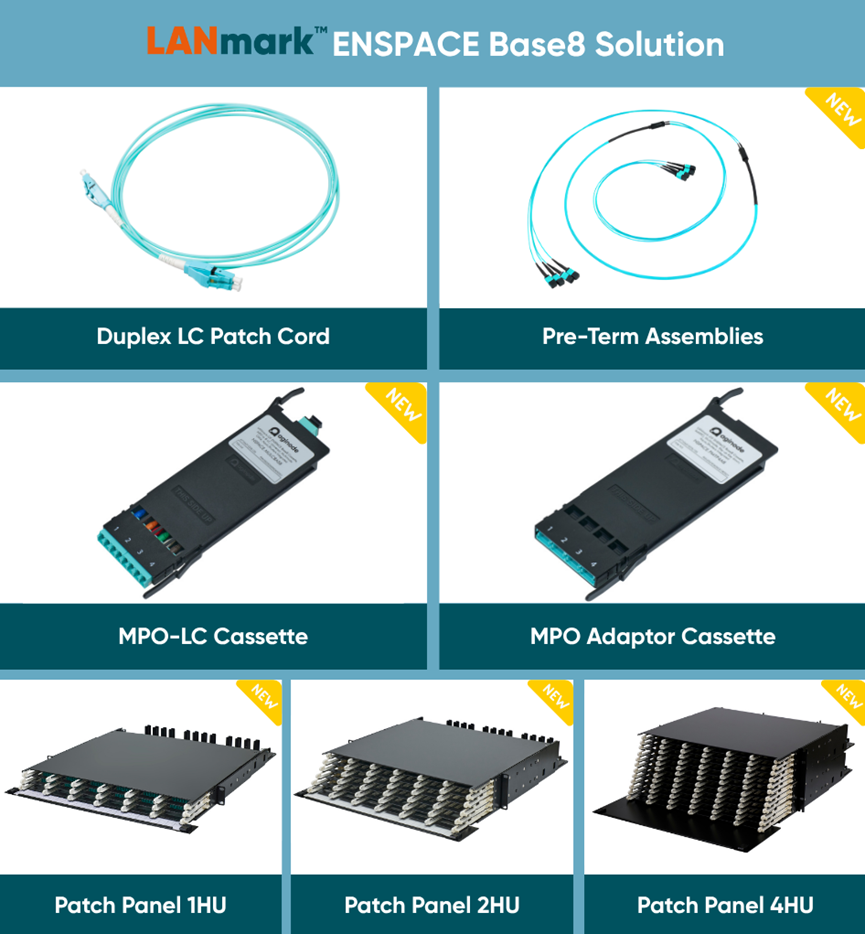
Engineered for seamless upgrades, optimal fibre utilisation, and simplified day-to-day operations, the ENSPACE Base8 platform provides a future-ready optical foundation — from 100G through 400G, 800G, and the roadmap beyond.
Whether you’re scaling an AI cluster, modernising an existing environment, or laying the groundwork for next-generation optical speeds, Aginode LANmark ENSPACE Base8 delivers the density, efficiency, and future-proofing today’s data centres demand.
If you’d like to learn more, explore design options, or discuss your upgrade path, feel free to reach out — we’re here to help you build what’s next.
*LANmark ENSPACE Base 8 solution is available in APAC and Middle East. Contact local sales for more information*
Share this
About the author
