DATA CENTRE
From optional to essential: FIBREROUTE in the 800G & 1.6T Era

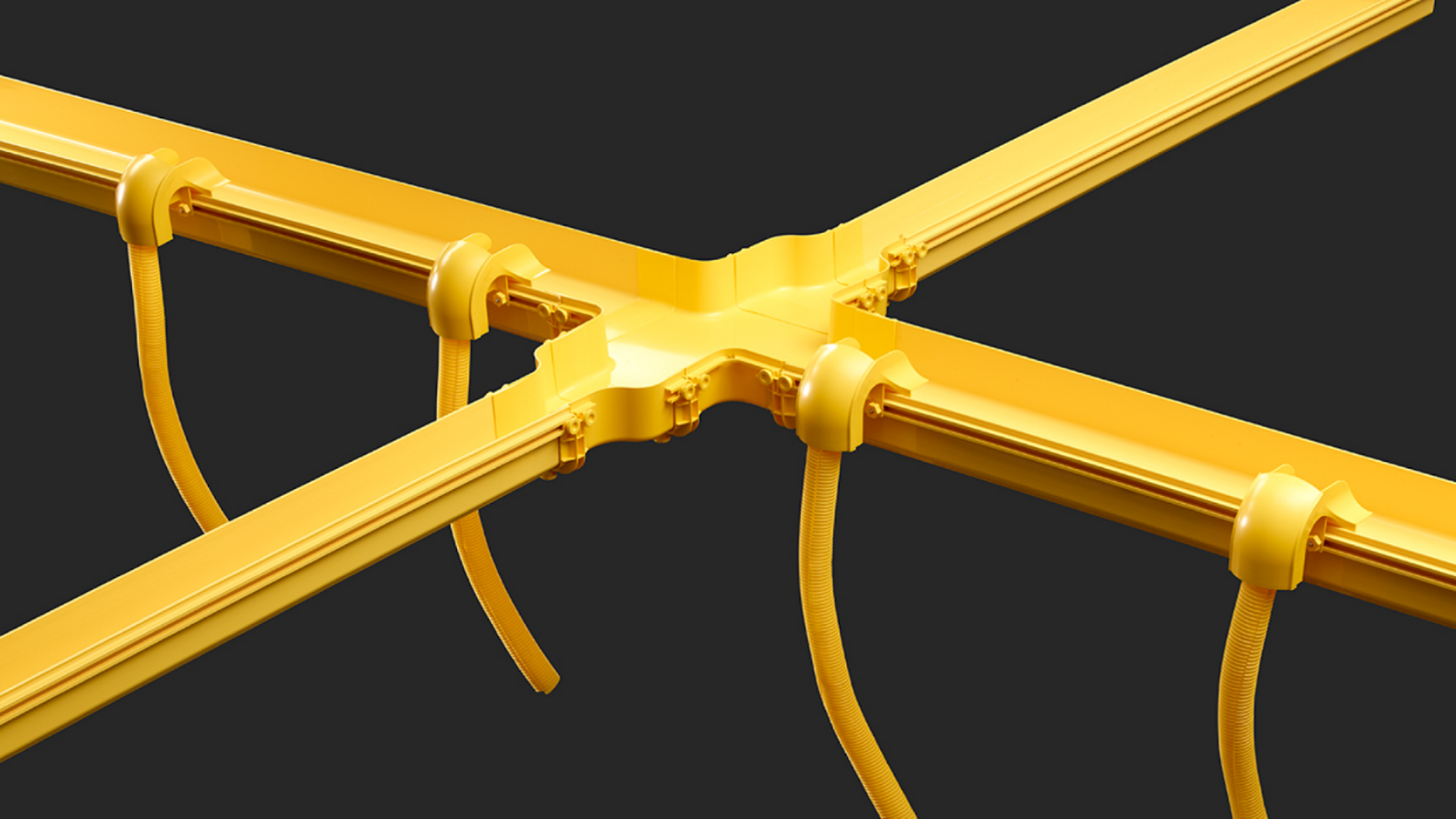
We are witnessing a fundamental shift in data centre architecture. As the industry races toward 800G and the upcoming 1.6T era, the physical infrastructure defining our networks is under immense pressure.
In this high-speed environment, optical fibre is no longer just a wire; it is a strategic asset. However, as core counts surge from dozens to thousands to support AI and HPC clusters, traditional mesh trays and unstructured cabling are becoming liabilities.
FIBREROUTE, Aginode’s dedicated fibre trunking system, transforms how facilities manage density. It proves that proper containment is no longer an accessory - it is a requirement for modern infrastructure.
Fibre as the main transmission medium in modern and AI Data Centres
The transition to optical interconnects is driven by more than just speed; it is about physical volume, efficiency, and stability in an increasingly noisy environment.
- The pressure of Rate Iteration: Data centres are aggressively upgrading from 100G/400G to 800G, with 1.6T on the horizon. This surge requires high-density, small-diameter fibres to handle massive throughput.
- The density of AI Clusters: AI and HPC clusters have unique physical demands. A single AI cabinet (such as the NVIDIA DGX SuperPOD) can require 20x the fibre quantity of a traditional cabinet to support massive parallel computing.
- Energy Efficiency: Fibre signal loss is roughly 1/100th that of copper, significantly reducing power consumption for signal transmission across large-scale deployments.
Why traditional cable trays are unsuitable for fibre cables
As core counts surge from dozens to thousands, traditional cable trays and unstructured cabling have become liabilities.
- Risk of physical damage: Traditional cable trays often have metal burrs or uneven surfaces. In high-density scenarios, the bottom layers of fibre cables face crushing weight and abrasion risk, which can lead to micro-bends or fractured cores.
- Airflow blockage: Without a dedicated pathway, high fibre counts lead to "spaghetti cabling" in cable trays. This creates significant wind resistance, blocking cold/hot aisle airflow and forcing cooling systems to work harder.
- Maintenance nightmares: In an open cable tray, identifying and removing a single cable from a tangled mass of thousands is risky and time-consuming, increasing the chance of accidental disconnection during maintenance.
Why FIBREROUTE?
If optical fibre is the lifeblood of the data centre, FIBREROUTE is the circulatory system. It transforms how facilities manage density through three key advantages:
- A leap in reliability (signal integrity):
- Bend radius control: FIBREROUTE strictly maintains a bend radius of ≥40mm. This prevents micro-bending losses, which are critical when every decibel of attenuation matters in 800G+ networks.
- Physical protection: The system features a smooth, fully enclosed interior that eliminates abrasion risks and protects the fibre sheath during pulling.
- Energy efficiency & airflow:
- Dedicated fibre routing channels help segregate low-mass fibre cabling from general overhead pathways, reducing congestion and supporting more predictable airflow patterns compared to conventional overhead cable tray systems.
- Improved airflow organisation can contribute to more efficient cooling operation and support incremental improvements in overall data centre Power Usage Effectiveness (PUE), particularly in high-density environments.
- Total Cost of Ownership (TCO):
- Faster deployment: Smooth inner walls reduce friction during cable pulling, shortening construction cycles.
- Agility: Movable fibre exits allow for fast expansion for additional cabinets in under 30 minutes, accommodating frequent topology changes in cloud businesses.
- Asset longevity: By protecting fibre from physical wear and heavy copper cables, the system extends the service life of your cabling investment.
How FIBREROUTE supports the semiconductor segment’s data centre
In the semiconductor industry, data centres serve as the "digital nervous system" of the manufacturing facility. While FIBREROUTE is not installed directly inside the fabrication clean rooms, it is critical for the on-premise data centres that control these precision environments.
- Designed for continuous operation: Semiconductor fabrication requires non-stop data transmission. The cost of downtime is astronomical. FIBREROUTE provides the physical security required to prevent signal interruption caused by cable stress or accidental human error during maintenance.
- Safety & compliance:
- Fire safety: The system utilizes UL94V0 flame-retardant materials, meeting strict facility safety standards.
- Electromagnetic isolation: It physically separates optical fibre from power cables, eliminating the risk of electromagnetic interference and accidental cable pulling during power maintenance.
- Future-ready scalability: As semiconductor manufacturing technology advances, the data volume generated by fabs grows exponentially. FIBREROUTE’s high-capacity, modular design ensures the facility's data centre is physically ready for 400G and 800G upgrades without requiring disruptive infrastructure overhauls.
Ready to secure your network’s future?
Don't let legacy infrastructure become the bottleneck for your 800G/1.6T upgrades. Choose the system that guarantees protection, efficiency, and scalability. Check out our FIBREROUTE catalogue and contact our team to discuss how we can streamline your network architecture.
Note: Aginode FIBREROUTE is currently only made available to customers in Asia and Middle East.
Share this
About the author